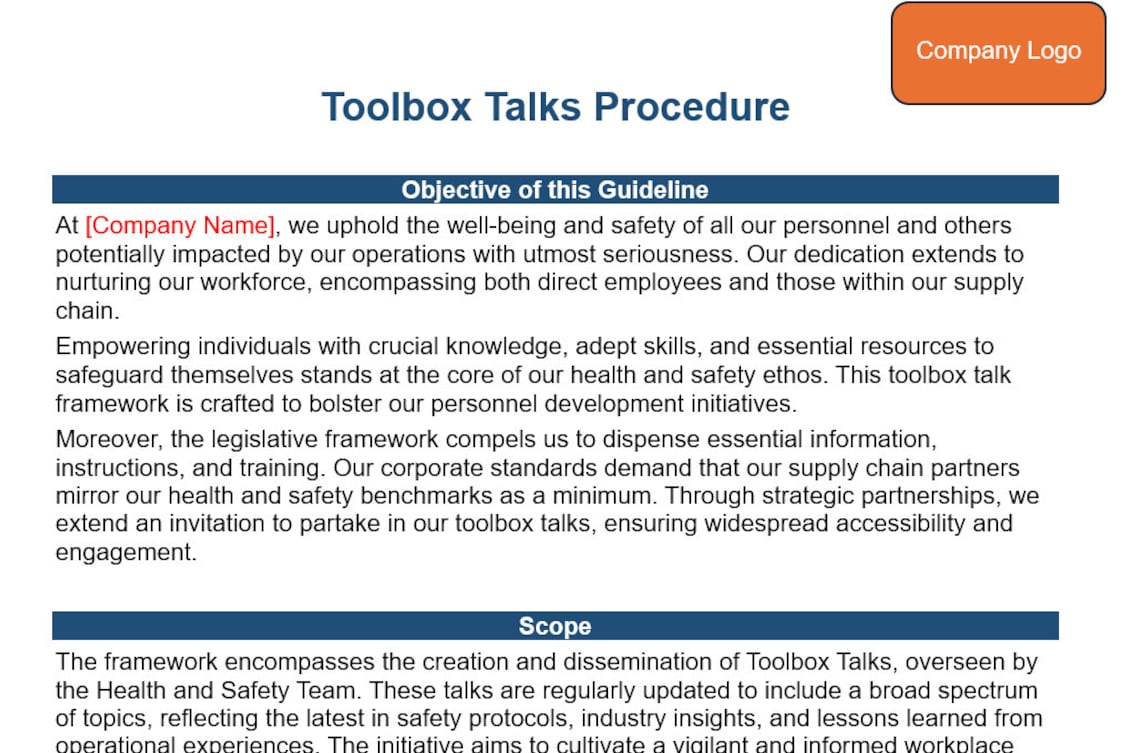
Safety doesn’t start with policy documents buried in a folder—it starts with conversation. On UK construction sites, manufacturing floors, and maintenance teams, the most effective safety interventions happen in real time, face-to-face. That’s where the toolbox talk template UK professionals rely on becomes essential.
A well-structured toolbox talk isn’t just a box-ticking exercise for HSE compliance. It’s a moment to align teams, clarify risks, and reinforce safe behaviours—especially when conditions change daily. Yet too many supervisors waste time reinventing the wheel each week or deliver vague, forgettable briefings. The solution? A reliable, adaptable toolbox talk template tailored for the UK work environment.
This guide breaks down what makes a toolbox talk template effective, how to customise it for different trades, and where to access high-quality, ready-to-use examples—without relying on outdated or generic formats.
Why UK Teams Need a Standardised Toolbox Talk Template
Toolbox talks are short, informal safety meetings typically held at the start of a shift or before a specific task. In the UK, they’re not legally mandated by the Health and Safety at Work Act—but they are a recognised best practice strongly encouraged by the HSE (Health and Safety Executive).
Without a consistent template, these sessions can become inconsistent or ineffective. A standardised format ensures: - Key topics aren’t missed (e.g. PPE, emergency procedures, task-specific hazards) - Attendance and engagement are tracked - Records exist for audits or incident investigations - Supervisors feel confident leading discussions, even without formal training
A good UK-focused template accounts for common regional risks—like working near live railways, confined spaces in older infrastructure, or seasonal hazards such as icy platforms in winter.
Common Mistakes That Undermine Effectiveness
Even with a template, many teams fall into traps: - Using the same topic every week – Repetition leads to disengagement. Rotate themes based on current site activity. - Reading verbatim from a sheet – Toolbox talks should be interactive. Encourage questions and real-world examples. - Failing to document properly – Without signed attendance sheets, you can’t prove compliance. - Ignoring worker feedback – If operatives raise concerns during the talk, log and act on them.
A template should guide, not dictate. The best versions include space for notes, discussion points, and follow-up actions.
Key Elements of an Effective UK Toolbox Talk Template
Your template must balance structure with flexibility. A rigid form won’t suit dynamic site conditions; a loose format risks missing key points. The following components should be included in any toolbox talk template used in the UK:
1. Session Details

- Date and time
- Location (e.g. “North Tower, Level 3”)
- Supervisor name and role
- Attendees (with signatures or printed names)
2. Topic & Objective Clearly state the focus:
Topic: Working at Height – Scaffolding Safety Objective: Ensure all operatives inspect guardrails and harness anchor points before starting work.
This keeps the conversation targeted.
3. Hazard Identification List 2–4 specific hazards related to the task:
- Unsecured edge protection
- Missing toe boards
- Improper use of fall arrest lanyards
Use plain language. Avoid jargon like “hierarchy of controls” unless explaining it simply.
4. Control Measures Pair each hazard
with a clear action:
- “Inspect guardrails before use—report damage to site manager.”
- “Harness must be worn and clipped at all times when on open edges.”
5. Discussion Prompts Include open questions to stimulate engagement:
- “Has anyone seen a near-miss with scaffolding this week?”
- “What would you do if you found a damaged plank?”
This turns passive listening into active participation.
6. Sign-Off Section All attendees should sign or initial. Digital signing via tablet is acceptable, provided records are securely stored.
Practical Toolbox Talk Topics for UK Workplaces
One-size-fits-all templates fail when they don’t reflect real work. Below are high-impact topics, each with a sample structure you can build into your template.
Working at Height (Common in Construction) Hazard: Falls from scaffolds, MEWPs, or fragile roofs Controls: Full PPE, pre-use checks, exclusion zones Discussion Prompt: “When was the last time you refused to work because a harness was damaged?”
Manual Handling (Warehousing, Facilities) Hazard: Back injuries from lifting heavy items Controls: Team lifts, trolleys, training refreshers Discussion Prompt: “Show us how you’d lift a 25kg box from a low shelf safely.”
Electrical Safety (Maintenance, Refurbishments) Hazard: Contact with live circuits during retrofit work Controls: Isolation procedures, lockout-tagout (LOTO), voltage testing Discussion Prompt: “What steps do you take before opening an electrical panel?”
Slips, Trips, and Falls (All Sites) Hazard: Wet surfaces, trailing cables, poor lighting Controls: Housekeeping schedules, cable protectors, signage Discussion Prompt: “Where have you seen a trip hazard this week?”
COSHH Exposure (Painting, Cleaning, Manufacturing) Hazard: Inhalation of fumes or contact with irritants Controls: Ventilation, correct PPE, SDS access Discussion Prompt: “Do you know where the COSHH data sheet is stored?”
These topics should rotate based on project phase and incident trends. For example, if your team reports three near-misses involving ladders in one month, make ladder safety a priority talk.
Adapting Your Template for Different Industries
While the core structure remains the same, industry-specific risks demand customised content.
Construction & Civil Engineering Focus on dynamic risks: excavation, crane operations, hot works. Include reference to CDM 2015 duties and competence checks.

Example: After a new concrete pour, run a talk on “Curing Safety – Barriers and Signage.” Highlight the risk of tripping over unseen formwork.
Facilities & Maintenance Emphasise lockout-tagout, confined space entry, and working alone. Templates should remind operatives to report isolation failures immediately.
Utilities (Gas, Water, Telecoms) Stress safe digging procedures, service identification, and emergency shutdown steps. Use maps or diagrams in your handouts.
Manufacturing Address machine guarding, moving parts, and noise exposure. Reinforce STOP cards or near-miss reporting culture.
A single master template can serve all departments—if it includes drop-down options or checkboxes for industry-specific hazards.
Where to Find Reliable Toolbox Talk Templates in the UK
Many companies waste time creating templates from scratch when high-quality, HSE-aligned options already exist. Below are five trusted sources for UK-ready toolbox talk templates:
| Provider | Format | Key Features | Best For |
|---|---|---|---|
| HSE Website | PDF/Print | Free, compliant with UK law | Basic compliance needs |
| NEBOSH Resource Hub | Editable Word/PowerPoint | Professionally designed, educational tone | Training teams |
| Barbour EHS | Digital platform + PDF | Integrated with risk assessments, auto-reminders | Large contractors |
| CHAS ( Contractors Health and Safety Assessment Scheme) | Customisable download | Pre-audit ready, client-accepted | Pre-qualification |
| SHP (Safety & Health Practitioner) | Weekly email templates | Fresh topics, real case studies | SMEs wanting variety |
Choose based on your team size and tech setup. For small firms, a simple Word template from CHAS may suffice. Larger organisations benefit from digital platforms like Barbour that centralise records.
Avoid generic international templates. US-based formats often reference OSHA standards or imperial measurements, which confuse UK operatives.
Making Toolbox Talks Engaging, Not Obligatory
A template ensures consistency—but engagement comes from delivery.
- Keep it short: 10–15 minutes max. Respect shift time.
- Use visuals: Photos of actual site conditions, not clip art.
- Rotate facilitators: Let experienced operatives lead occasionally.
- Link to incidents: If a nearby site had a fall, use it as a talking point.
- Reward participation: A £5 voucher for the best safety suggestion builds culture.
One London-based contractor reduced incidents by 40% in six months simply by adding a “What’s one thing we can improve?” question to every talk—and acting on the answers.
Final Tips for Sustainable Success
- Review quarterly: Update templates to reflect new risks or equipment.
- Store digitally: Use cloud folders with access controls for audit trails.
- Train supervisors: Even brief coaching on facilitation improves outcomes.
- Don’t standardise too much: Allow space for site-specific risks to be added.
A toolbox talk template UK teams can rely on isn’t just a document—it’s a tool for building a proactive safety culture. When done well, it turns daily routines into moments of real impact.
Start with a solid template, adapt it to your context, and prioritise conversation over compliance. That’s how safety becomes second nature.
Frequently Asked Questions
What is a toolbox talk template? A structured document used to guide short safety meetings on UK worksites, covering hazards, controls, and discussion points for specific tasks.
Are toolbox talks a legal requirement in the UK? No, they’re not legally mandatory, but they are a recognised best practice recommended by the HSE and often required by contractors and clients.
How often should toolbox talks be held? Typically weekly or before high-risk tasks. Frequency should match site activity and risk levels.
Who should lead a toolbox talk? Site supervisors, managers, or competent operatives with knowledge of the task and safety procedures.
Can toolbox talks be digital? Yes—many UK firms use tablets or apps to record attendance, deliver content, and store records securely.
Should toolbox talk records be kept? Yes. Signed attendance sheets and topic logs must be retained for audits, incident investigations, or HSE inspections.
How long should a toolbox talk last? Ideally 10 to 15 minutes—long enough to cover key points, short enough to maintain focus.
FAQ
What should you look for in Toolbox Talk Template UK: Practical Guides for Safety Success? Focus on relevance, practical value, and how well the solution matches real user intent.
Is Toolbox Talk Template UK: Practical Guides for Safety Success suitable for beginners? That depends on the workflow, but a clear step-by-step approach usually makes it easier to start.
How do you compare options around Toolbox Talk Template UK: Practical Guides for Safety Success? Compare features, trust signals, limitations, pricing, and ease of implementation.
What mistakes should you avoid? Avoid generic choices, weak validation, and decisions based only on marketing claims.
What is the next best step? Shortlist the most relevant options, validate them quickly, and refine from real-world results.


