Stuart’s comic book store was always a sanctuary for misfits. But no one expected it to become the launchpad for a cosmic sitcom where the quiet, self-deprecating manager becomes the universe’s last, least likely hope. The first look at Stuart Fails to Save the Universe—the newest spinoff from the Big Bang Theory universe—confirms what fans have long suspected: the most overlooked character might just be the most human.
This isn’t Sheldon in a new lab coat. It’s not another story about genius-level intellects solving string theory over takeout. This is a grounded, heartfelt comedy about anxiety, existential dread, and the quiet courage of ordinary people thrown into extraordinary roles. And at the center of it all is Stuart Bloom, played once again by Kevin Sussman, stepping fully into the spotlight.
Why Stuart? The Unlikely Hero of the Big Bang Legacy For over a decade, Stuart existed in the background—borrowing money, hosting game nights, quietly pining for Emily, and surviving on ramen and discounted comics. He was the perpetual sidekick, the guy who showed up but rarely led. So why build a spinoff around him?
Because in the shadow of genius, Stuart was always the emotional anchor.
While the physicists debated multiverse theory, Stuart dealt with real-world crises: bankruptcy, loneliness, social anxiety, and the struggle to be seen. That relatability is the foundation of the new show. Stuart Fails to Save the Universe isn’t a sci-fi epic. It’s a metaphorical journey—Stuart’s internal battle to matter, to connect, to survive emotionally in a world that often ignores people like him.
The “universe” he’s failing to save? It’s not galaxies and wormholes. It’s his relationships, his self-worth, his comic shop, and the fragile community that gathers there.
First Look: What the Teaser Reveals
The initial footage, released at CBS’s upfront presentation, opens with a surreal animated sequence: a glowing orb warns a council of interdimensional beings that “the Chosen One has been identified.” Cut to: Stuart, asleep on a folding cot in the back room of the comic shop, mouth open, drooling onto a Silver Surfer #1 reprint.
When a mysterious device crashes through the window—a glowing, cube-shaped artifact that hums with unknown energy—Stuart assumes it’s either a prank from Leonard or a sign he’s finally cracked under financial pressure. But when the cube speaks (in the voice of Tilda Swinton, no less), calling him “the Catalyst of Convergence,” the show leans hard into absurdity with emotional sincerity.
“You are not powerful. You are not brave. But you are precisely unremarkable enough to shift the balance,” the cube intones.
This tonal blend—surreal premise meets quiet realism—is the show’s tightrope walk. Early scenes balance laugh-out-loud moments (Stuart trying to return the cube to “Customer Service: Multiverse Division”) with poignant flashbacks to his childhood, his failed art career, and his complicated relationship with his absent father.
The Supporting Cast: New Faces, Familiar Vibes
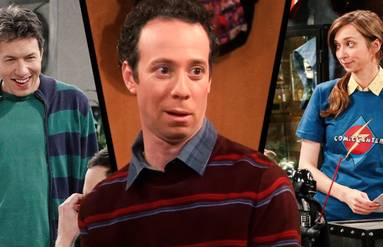
The comic shop becomes a hub for new regulars, each representing a different emotional challenge for Stuart:
- Maya (Zoe Jarman): A teenage runaway with a knack for coding and a sharp tongue. She’s the first to believe the cube is real—and the first to call Stuart out on his self-sabotage.
- Darnell (Lamorne Morris): A retired firefighter who now runs the laundromat next door. He becomes Stuart’s reluctant mentor in masculinity, resilience, and how to cook something besides ramen.
- Dr. Lillian Cho (Stephanie Hsu): A quantum physicist who initially dismisses the cube as pseudoscience—until it starts predicting minor events with eerie accuracy. Her arc explores the friction between empirical proof and emotional truth.
And yes—cameos are coming. Jim Parsons returns in a dream sequence as a hallucinatory version of Sheldon, offering unsolicited advice on “optimal universe-saving efficiency.” Simon Helberg and Kunal Nayyar appear in voice cameos as Howard and Raj, arguing over a podcast titled Aliens Ate My Laundry.
But the show avoids nostalgia bait. These appearances serve Stuart’s journey, not the audience’s.
Tone and Style: A Departure from Pasadena
Stuart Fails to Save the Universe ditches the familiar multi-cam setup and laugh track of The Big Bang Theory. Instead, it adopts a single-camera, half-hour format with cinematic lighting and a melancholic-comedic score reminiscent of Ted Lasso or Abbott Elementary.
The comic shop—once a cluttered backdrop—is now a character in its own right. Every shelf, poster, and Funko Pop tells a story. The camera lingers on Stuart’s hands as he repairs a damaged comic, or on the flickering neon Open sign that never quite works right.
Visually, the show contrasts the gritty realism of Stuart’s world with surreal dream sequences where he’s floating through space, dodging black holes shaped like rejection letters and anxiety spirals. These moments aren’t escapes—they’re manifestations of his psyche.
Stuart’s Flaws Are the Plot
The title isn’t hyperbole. Stuart does fail—to pay rent, to confess his feelings, to believe the cube, to show up on time. But those failures aren’t punchlines. They’re the engine of growth.
In Episode 3 (leaked via production blog), the cube activates a “parallel self” from a universe where Stuart became a famous artist. This version is confident, wealthy, surrounded by admirers. But when Stuart asks how he did it, the doppelgänger breaks down: “I stopped caring what anyone thought. But I also stopped feeling anything at all.”
That moment crystallizes the show’s theme: success without connection is its own kind of collapse.
Stuart’s journey isn’t about becoming a hero. It’s about realizing he already is one—just not in the way pop culture defines it.
Behind the Scenes: Chuck Lorre’s Late-Career Reinvention
Chuck Lorre, co-creator of The Big Bang Theory, serves as executive producer alongside Steven Molaro and a new wave of writers from underrepresented comedy backgrounds. In interviews, Lorre has called this project “a redemption arc 15 years in the making.”
“We spent years laughing at Stuart’s insecurity. Now we’re finally listening to it.”
That shift is evident in the writing room’s approach. Jokes still land, but they’re rooted in character, not stereotype. The show avoids mocking Stuart’s social anxiety—it explores it with empathy.
Kevin Sussman, who has advocated for a Stuart-led story since 2015, now has co-story credit on the pilot. His performance is quieter, more layered than ever. He doesn’t need punchlines to command the screen. A single glance at an unpaid bill or a missed text speaks volumes.
Is This the Future of Sitcom Spinoffs?
Stuart Fails to Save the Universe signals a broader trend: spinoffs that center marginalized characters not for novelty, but for narrative depth.
Think of Frasier, Better Call Saul, or Young Sheldon. The most successful spinoffs don’t just extend a franchise—they challenge it. They ask: Who was being overlooked? Whose story was simplified?
Stuart was the guy who borrowed $20 “until payday,” who laughed too hard at bad jokes, who never got the girl. But in giving him the lead, the show reframes the entire Big Bang universe. Suddenly, the geniuses don’t seem quite so wise. And the quiet guy in the back?
He might just understand the human condition better than all of them.
Why This Could Resonate in 2024
We’re living in an age of burnout, disconnection, and quiet desperation. Millions feel unseen, underqualified, overwhelmed. Stuart Fails to Save the Universe speaks directly to that audience.
It’s not about winning. It’s about showing up. It’s about failing—and trying again. The “universe” Stuart’s saving might be metaphorical, but the stakes feel real.
And in a media landscape saturated with superheroes and geniuses, a show about an anxious, broke comic book clerk discovering his worth might be the most radical idea of all.
Final Thoughts: Watch It for the Laughs, Stay for the Heart
Stuart Fails to Save the Universe isn’t trying to replace The Big Bang Theory. It’s trying to deepen it. By shifting focus from intellect to emotional resilience, from certainty to doubt, it expands what a sitcom can be.
The first look promises more than nostalgia. It offers transformation—not of the man, but of how we see him.
If you’ve ever felt like the universe was passing you by, this show is your invitation to step into the light—even if you trip on the way.
FAQ
Was Stuart always planned to get a spinoff? No—though Kevin Sussman and fans have long advocated for it. The idea gained traction after the Big Bang Theory finale highlighted Stuart’s growth.
Is the cube real in the show’s universe? Yes and no. It’s a supernatural device, but its power stems from Stuart’s choices—not magic or tech.
Will any original cast members be regulars? No. Cameos are limited and story-driven. The focus stays on Stuart’s new world.
Is the show a comedy or a drama? It’s a dramedy—funny in the moment, but emotionally layered. Think Ted Lasso meets Fleabag.
Where is the comic shop located? Still in Pasadena—but now with a new mural painted by local teens, symbolizing community rebirth.
How many episodes are in the first season? 13 episodes, with a winter finale that leaves the cube’s origin unresolved.
Is the show suitable for Big Bang Theory fans who dislike spinoffs? Yes—if you’re open to tonal evolution. This isn’t Young Sheldon. It’s something quieter, riskier, and more human.
FAQ
What should you look for in Stuart Takes Center Stage in New Big Bang Theory Spinoff? Focus on relevance, practical value, and how well the solution matches real user intent.
Is Stuart Takes Center Stage in New Big Bang Theory Spinoff suitable for beginners? That depends on the workflow, but a clear step-by-step approach usually makes it easier to start.
How do you compare options around Stuart Takes Center Stage in New Big Bang Theory Spinoff? Compare features, trust signals, limitations, pricing, and ease of implementation.
What mistakes should you avoid? Avoid generic choices, weak validation, and decisions based only on marketing claims.
What is the next best step? Shortlist the most relevant options, validate them quickly, and refine from real-world results.